
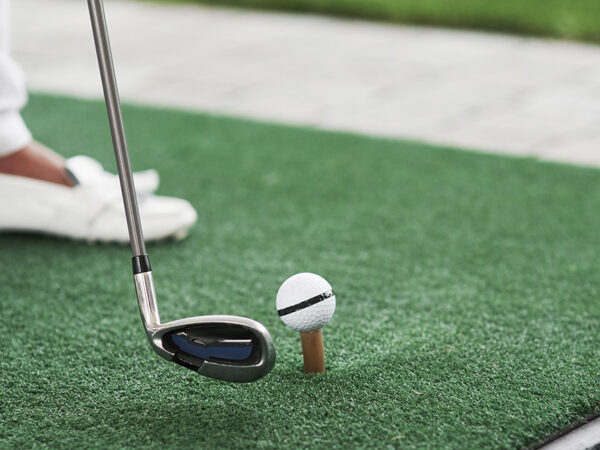
Mini-golf isn’t won with power. It’s won with precision. There are no long fairways here and no reason for a driver – the whole game fits into a few feet of green between the ball and the cup. A full shoulder turn on a course this size isn’t just useless; it’s how balls end up off the course.
The good news: putting breaks down into three parts – stance, line, and stroke – and the whole thing can be picked up in a single evening.
Stance: what to check
Five things need attention: back, shoulders, feet, elbows, and eyes. That covers the body top to bottom. That sounds like a lot, but the five add up to a single position, and finding it once is enough.
The back sits at roughly a 45-degree angle, with the shoulders directly over the feet – no folding in half. Elbows stay soft, never locked; stiff arms turn a smooth putt into a shove.
Most important of all: eyes down. Not just while settling over the ball, but all the way through the stroke. The cup doesn’t need watching, and neither does anyone else on the course. The ball does. Looking up early to see where the ball went is the single most common reason players miss from a foot away.
The line: map it before the stroke
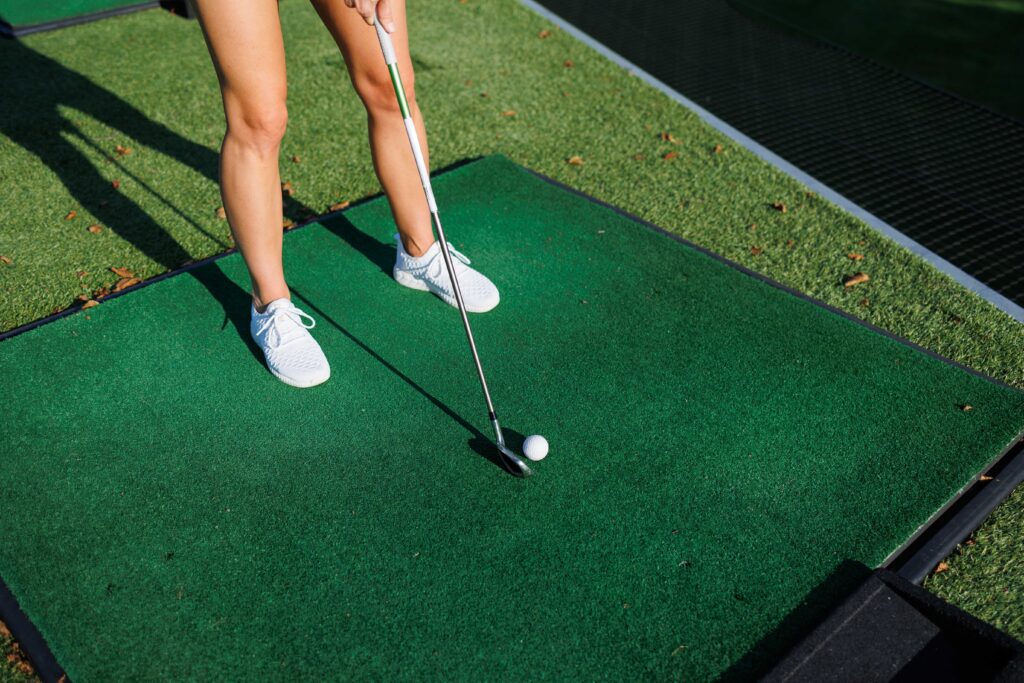
There’s a thin alignment mark on the head of most putters. Plenty of players never notice it. That’s a wasted advantage – it does most of the work of lining up a putt.
The mark is the last step, though, not the first. Visualization comes before it: a slow look across the green that takes in walls, slopes, and rough patches where the ball will bleed speed. Then a mental line runs from the ball to the hole – the line the ball will actually travel, not the straight one that looks right.
Next come two or three practice strokes beside the ball. That isn’t superstition; it’s how the right length of stroke gets into muscle memory before the one that counts.
Bank shots are unavoidable in mini-golf, and they work differently from a straight putt. Two lines are in play instead of one. The first runs from the ball to the chosen point on the wall; the second runs from that point to the cup. Standing at the bounce point makes the second line far easier to see. The mark on the putter confirms the geometry: the angle in should match the angle out. To be exact, a coin or a bottle cap on the turf can mark the contact point. A real target beats an imaginary dot on a wall.
The stroke: how it moves, how far it goes, how it finishes
This is the easy part, assuming the stance and the line were done properly. Movement, distance, and finish build on each other.
The motion comes from the shoulders. Only the shoulders. Feet planted, head still, wrists quiet – the upper body works like a pendulum.
That pendulum also controls how far the ball travels. Distance comes from the length of the stroke, not from how hard the ball is struck. The arc stays short: a few inches back, a few inches through. A putter never needs to rise above knee height. On a mini-golf course, a full swing puts the ball two holes away.
Short doesn’t mean abrupt. The finish is the part that gets skipped. The putter doesn’t stop at contact – it keeps traveling along the same line. Cutting it short sends the ball off line. The stroke runs through, head down, until the ball drops.
Quick pre-shot checklist

- Back at about 45 degrees, shoulders over feet, elbows soft
- Line chosen, with slopes, walls, and rough patches accounted for
- Two or three practice strokes beside the ball
- Eyes on the ball through the entire stroke
- Short arc, full finish
Mini-golf rewards precision over power, and precision is mostly a matter of preparation. After three or four rounds with that checklist in mind, the difference starts showing on the scorecard. Westerville, Ohio, has enough courses to practice on – outdoor, indoor, and a few under black light.