
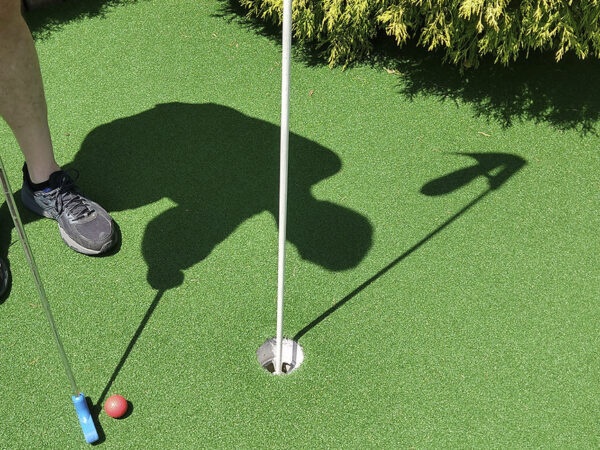
Mini golf takes one piece of traditional golf, the putt, and builds a whole game around it. The objective stays the same: the ball goes into the hole in as few strokes as possible. The course is what changes. Fairways and sand traps give way to short lanes with rails, ramps, tunnels, sharp turns, and themed decor. Every hole becomes a small puzzle of its own.
Almost nothing has to be learned in advance. Experience with the full-size game helps with stroke mechanics but provides little real advantage: over a few yards of putting surface, reading the angle and controlling the pace of the ball matter more.
The format exists in two versions across central Ohio, Westerville included. Outdoor courses run from late spring into fall, weather permitting. Indoor venues, often built around neon decor and blacklights, stay open year-round and are unaffected by rain or snow.
Equipment
One of the main advantages of the format is that nothing has to be brought along. The full kit is handed out on site.
The Putter
A round of mini golf runs on a single club. The putter is short enough to control with one hand, light enough to carry all afternoon, and flat-faced, since nothing here calls for lifting the ball off the ground. A couple of strokes are usually enough to get comfortable with it. Putters come in different lengths, so matching the club to the player’s height before the first hole is worth the few seconds it takes; a poorly sized club makes a consistent stance hard to hold. Swapping it mid-round is normally not an issue.
The Ball
Every player gets a ball and plays it through to the end of the round. Mini golf balls are softer and a shade heavier than regulation ones, which keeps them from bouncing off the rails, and they arrive in a spread of colors, one per player. Under UV lighting indoors, those same balls glow.
The Scorecard and Pencil
The scorecard is handed out before the start; it records the number of strokes per hole for each participant. The scoring system is simple, and the staff explains it before play begins. Keeping score is optional: plenty of groups walk the course purely for the experience.
The Basic Rules
The principle is the same as in the full-size game: finish each hole in as few strokes as possible, and the lowest total across all holes wins.
Players take turns, usually in the order listed on the scorecard. More experienced groups follow a different convention: whoever posts the best score on the previous hole goes first. On each hole, a player keeps putting until the ball drops.
Nearly every course sets a stroke limit, and six or seven is standard. If the ball is not in the cup by then, the maximum is recorded and play moves on. That keeps a single hole from dragging and holds the pace steady. A full 18-hole round takes 45 to 60 minutes; a large group or a busy evening pushes it past that.
Standard golf conventions apply as well: the ball is played from wherever it stops, and a ball that leaves the lane is returned to the point where it went out, and a penalty stroke is added. Decor, moving figures, and lighting change none of that.
Playing Tips
A Steady Stance
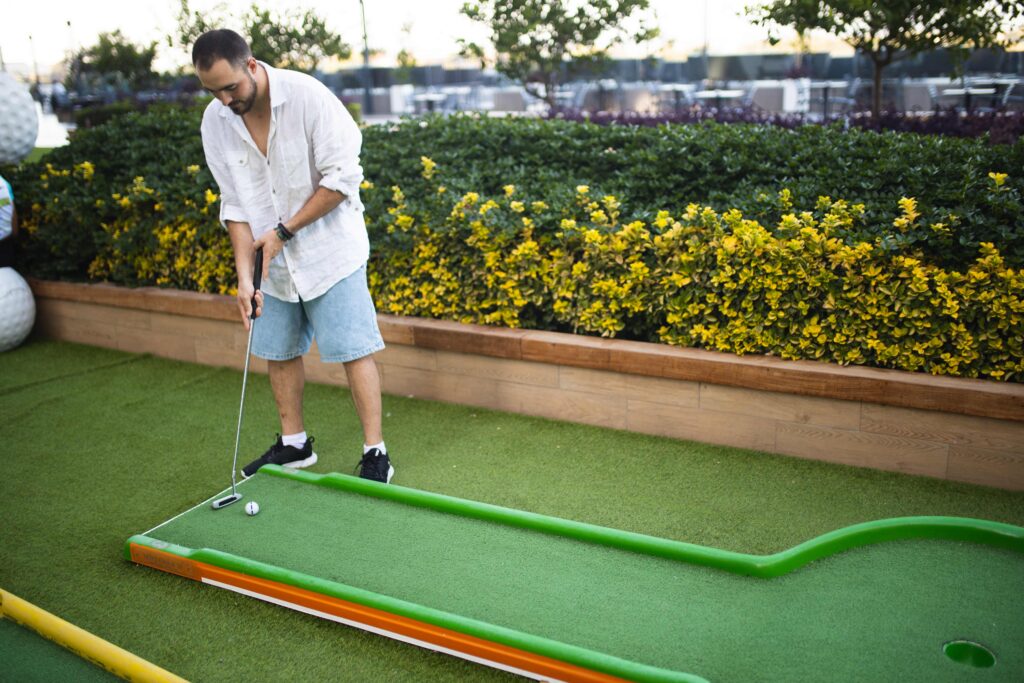
Control of the putter starts with body position. The feet are set about shoulder-width apart, the knees bend slightly, both hands grip the club, and the eyes remain on the ball. Everything below the shoulders stays quiet. The stroke travels through the arms in one smooth arc, and the wrists never snap.
A couple of slow practice swings before a shot help establish the range of motion. Adding power afterward is easier than undoing the damage from a stroke that comes off too hard.
Strategy Over Speed
On a short lane, a hard stroke usually backfires: the ball ricochets off the rail and ends up farther from the cup than it started. Reading the route first pays off – the slope of the surface, the position of the obstacles, and the likely bounce points.
The straight line is not always the best line. A stroke played off the rail, a curve around an obstacle, or a deliberate approach that leaves the ball beside the cup for an easier follow-up often work better than a direct run at the hole.
The Right Frame of Mind
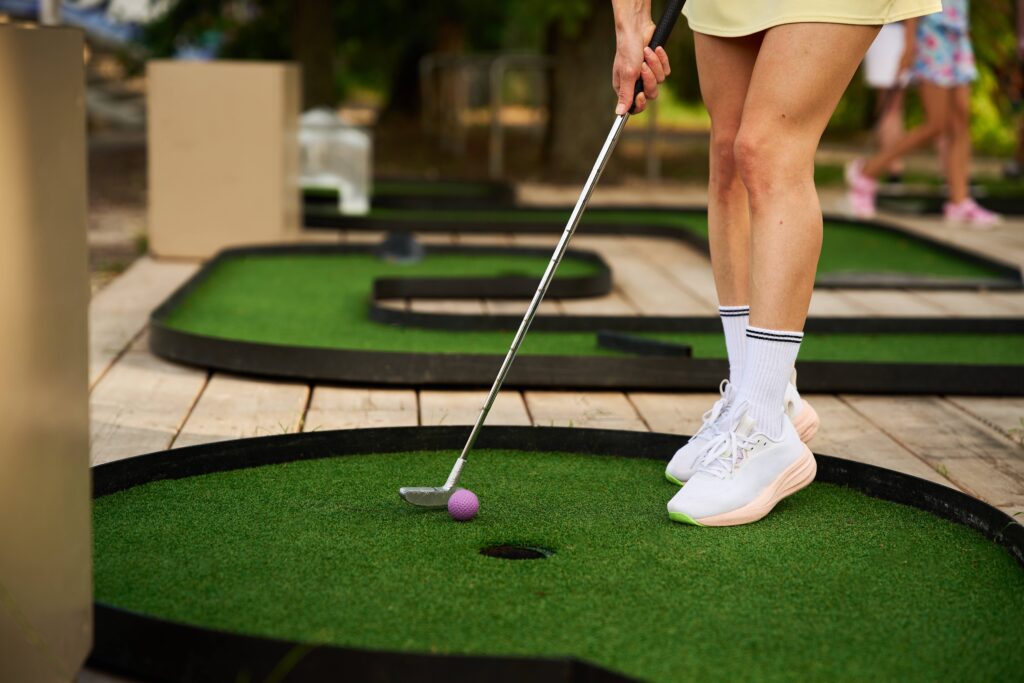
The point of the format is not the score. Missed shots are part of it: the ball sticks in a tunnel, kicks the wrong way, circles the cup, and rolls back out. Those are the moments that get remembered. A relaxed attitude toward bad strokes also shows up on the scorecard – tension wrecks technique faster than any obstacle on the lane.
What Else Mini Golf Courses Offer
Mini golf rarely stands on its own. More often it sits inside an entertainment center, with an arcade floor nearby – everything from classic cabinets to VR rigs. Some venues add bowling, laser tag, or a laser maze.
That mix suits birthdays, corporate events, and family outings: the program does not end at the 18th hole, and groups with different interests find something under one roof.
Choosing a Course in Westerville
A few factors separate one course from another. Indoor or outdoor sets the season: open-air lanes follow the weather, while indoor venues run year-round. Route length comes next, with 18 holes as the standard and 9-hole layouts common at smaller sites. After that come the extras on site and the crowd level. Friday and Saturday evenings and school breaks are the peak; weekday mornings run considerably quieter.
Public courses compress the range of possible outcomes. Short lanes cap how much technique can be exploited, so scores across a mixed group tend to land within a few strokes of one another. That is the main reason the format has held on for decades.